


Superb SBH - Wiwen Sweden Modernist Sterling Necklace Bracelet Set 1946/1951
- Regular price
-
$2,295.00 - Regular price
-
- Sale price
-
$2,295.00
Couldn't load pickup availability
Superb Sven Börje Hasselgrens and
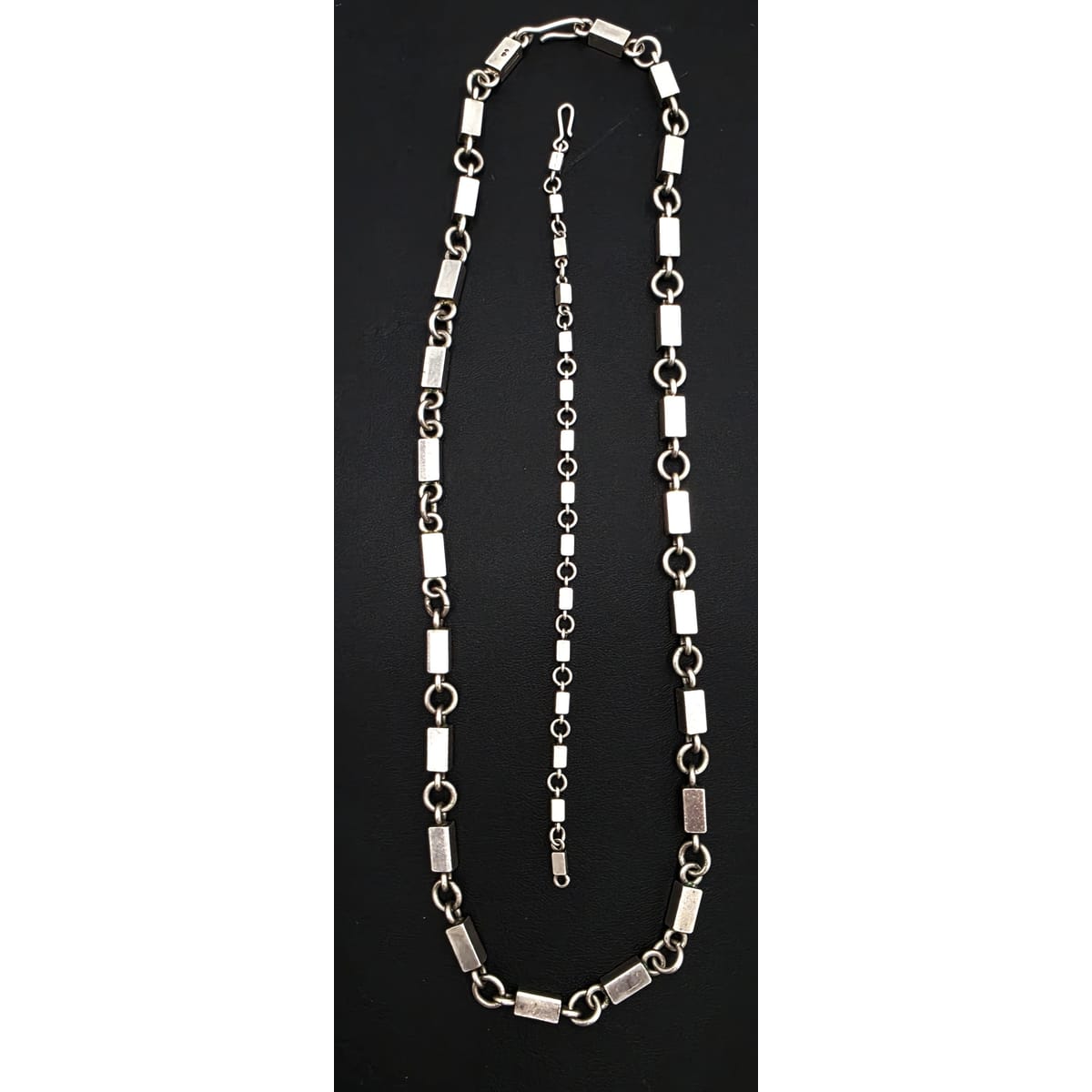
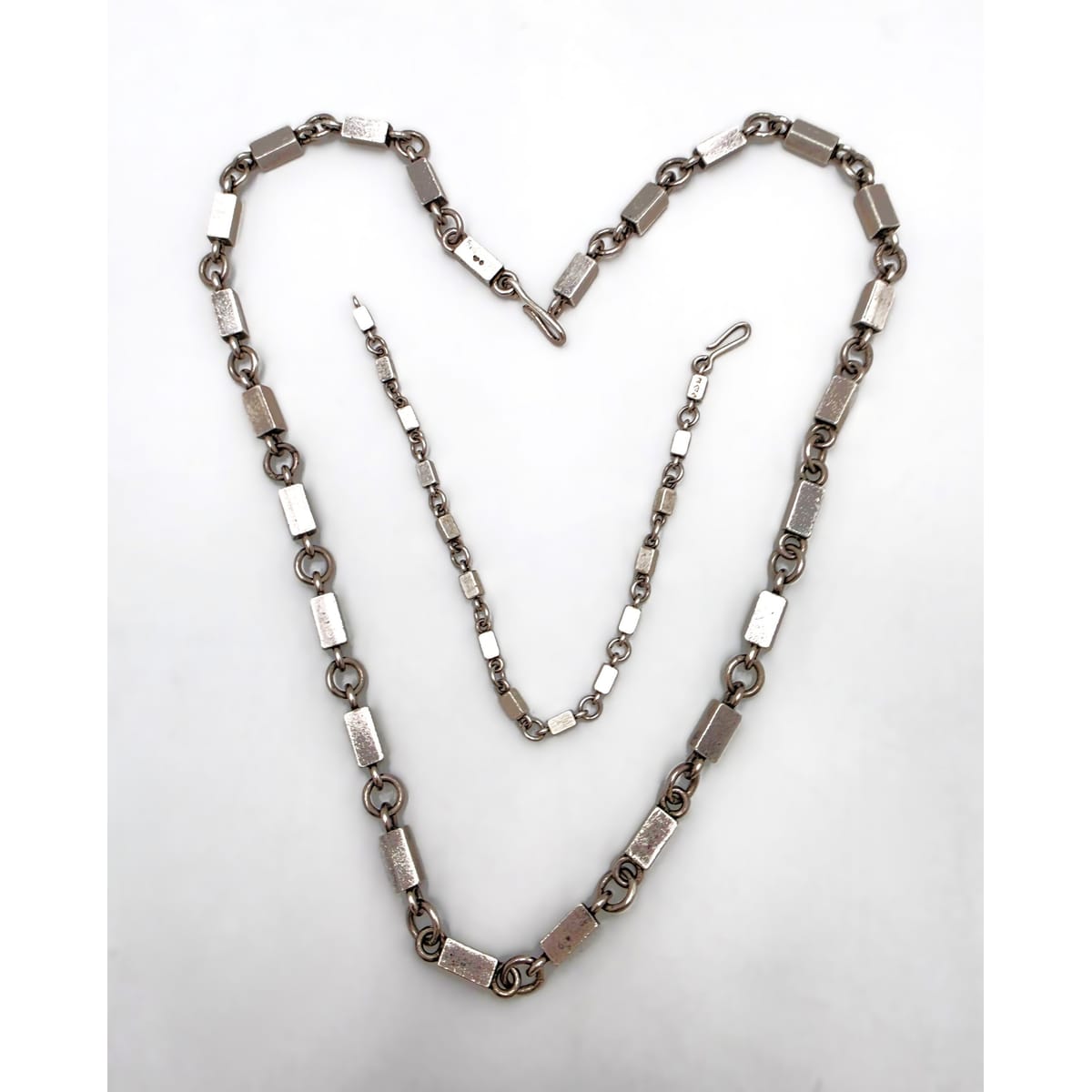
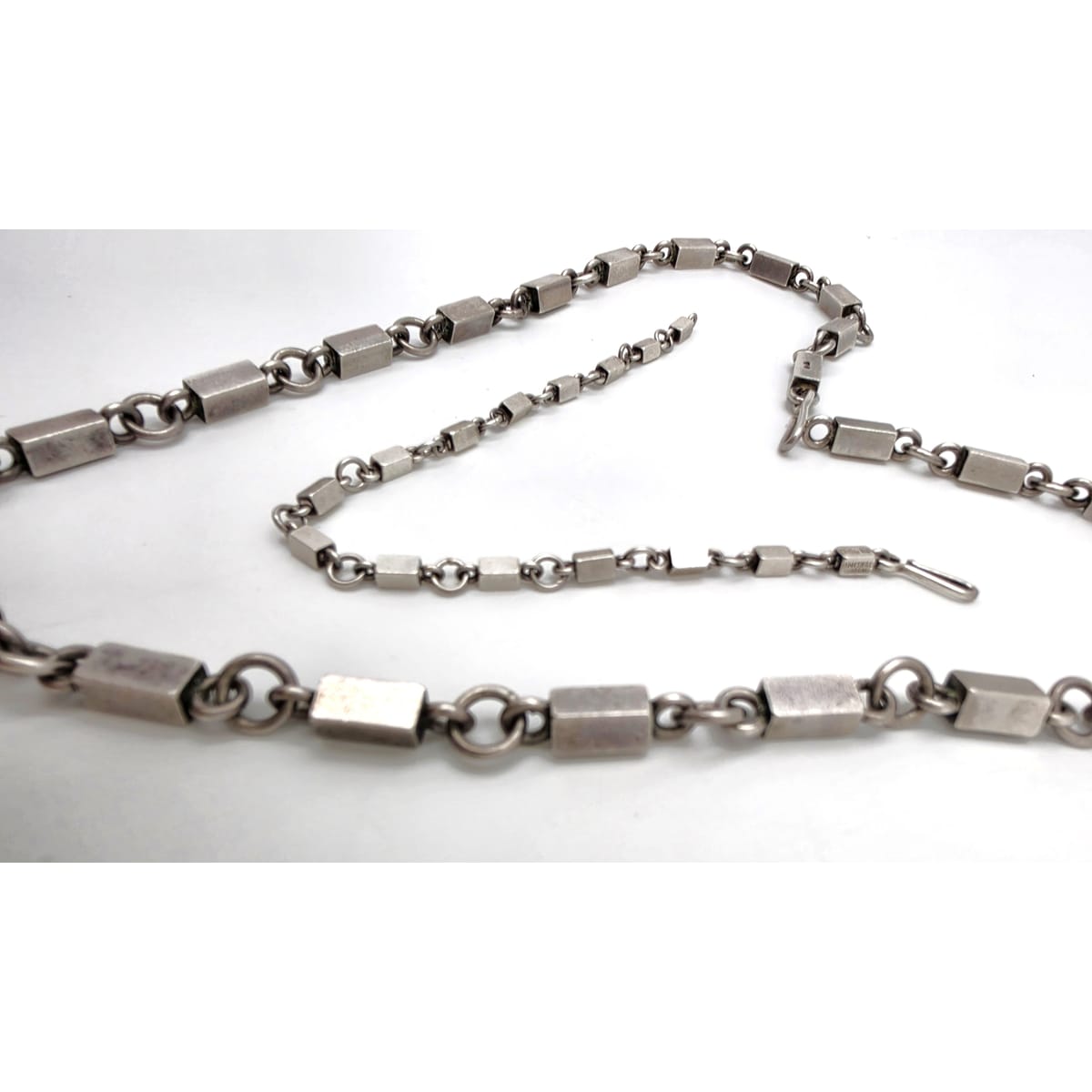
Wiwen Sweden Modernist Sterling Silver Block and Chain Link Necklace and Bracelet Set Dated 1946/1951
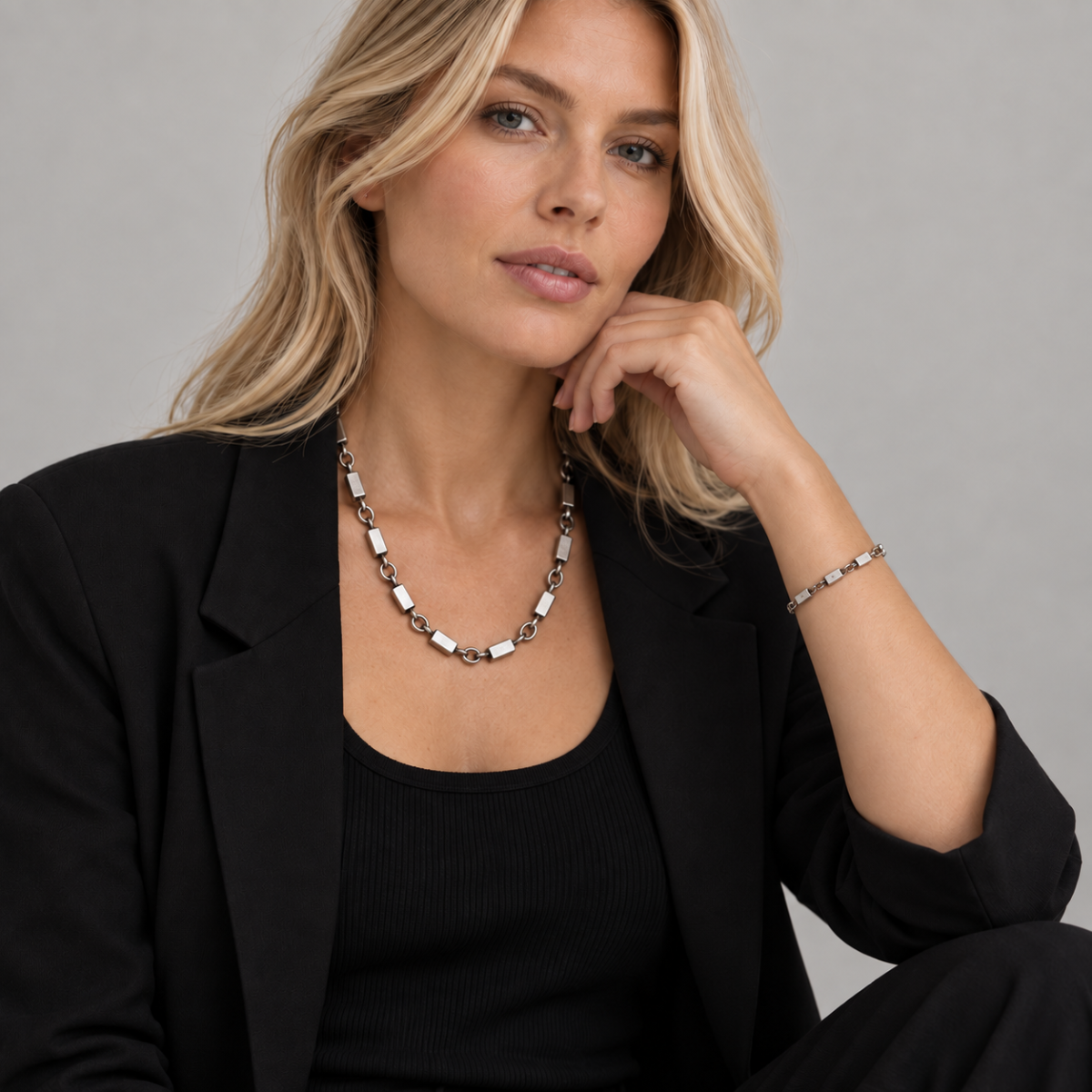
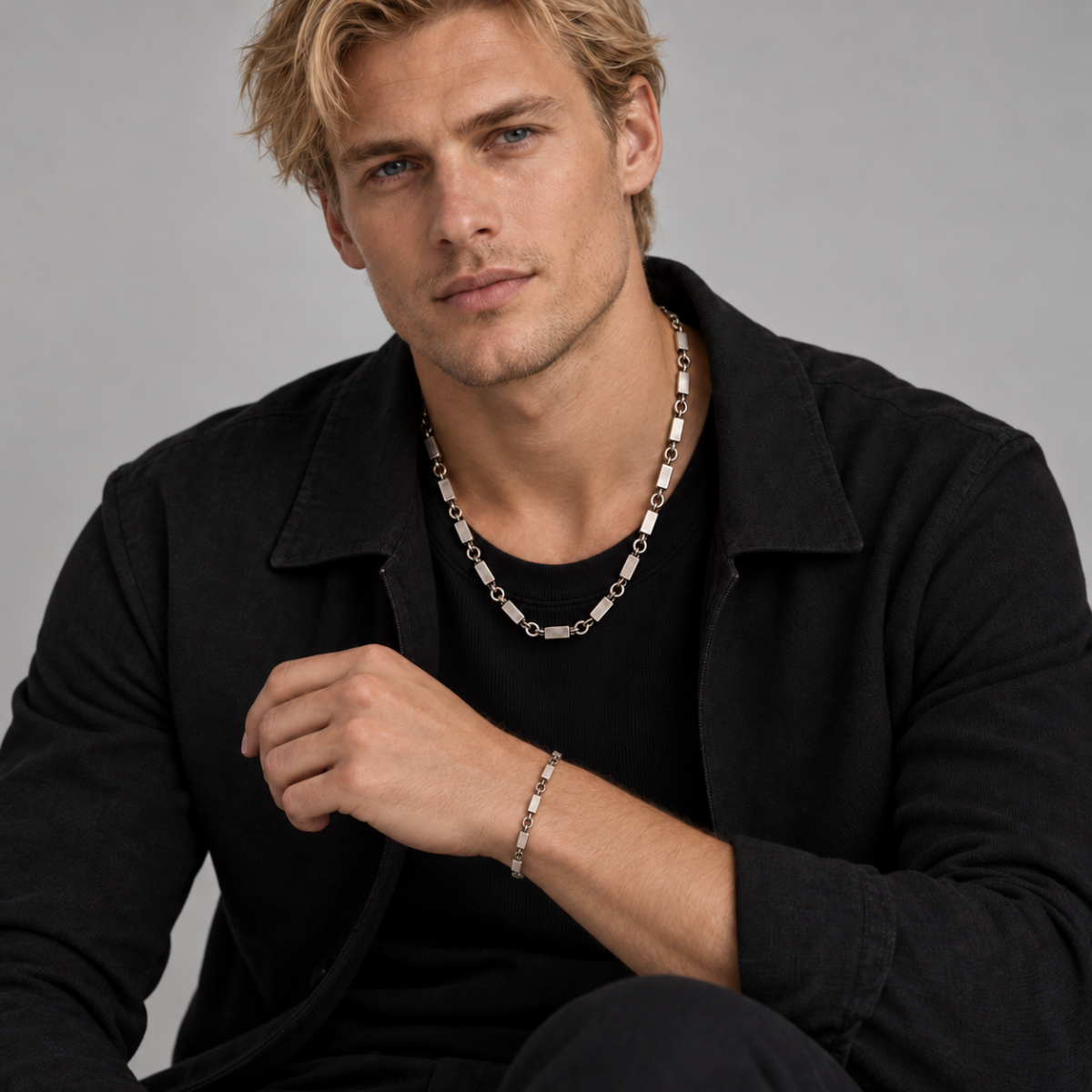
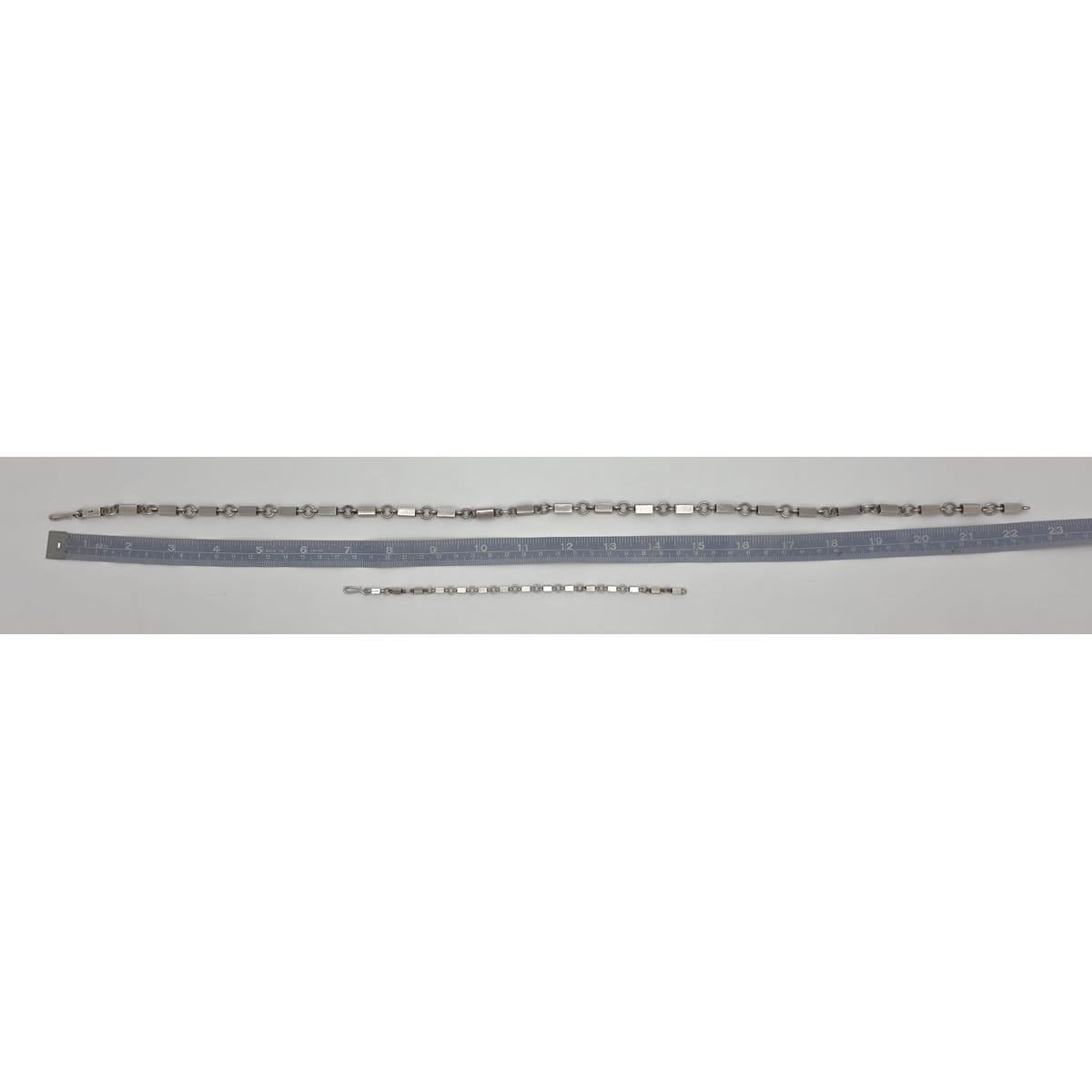
Measurements: Necklace: 22.5"L x .25"W (57.15cm x .64cm)
Bracelet: 7.9"L x .25"W (20.07cm x .64cm)
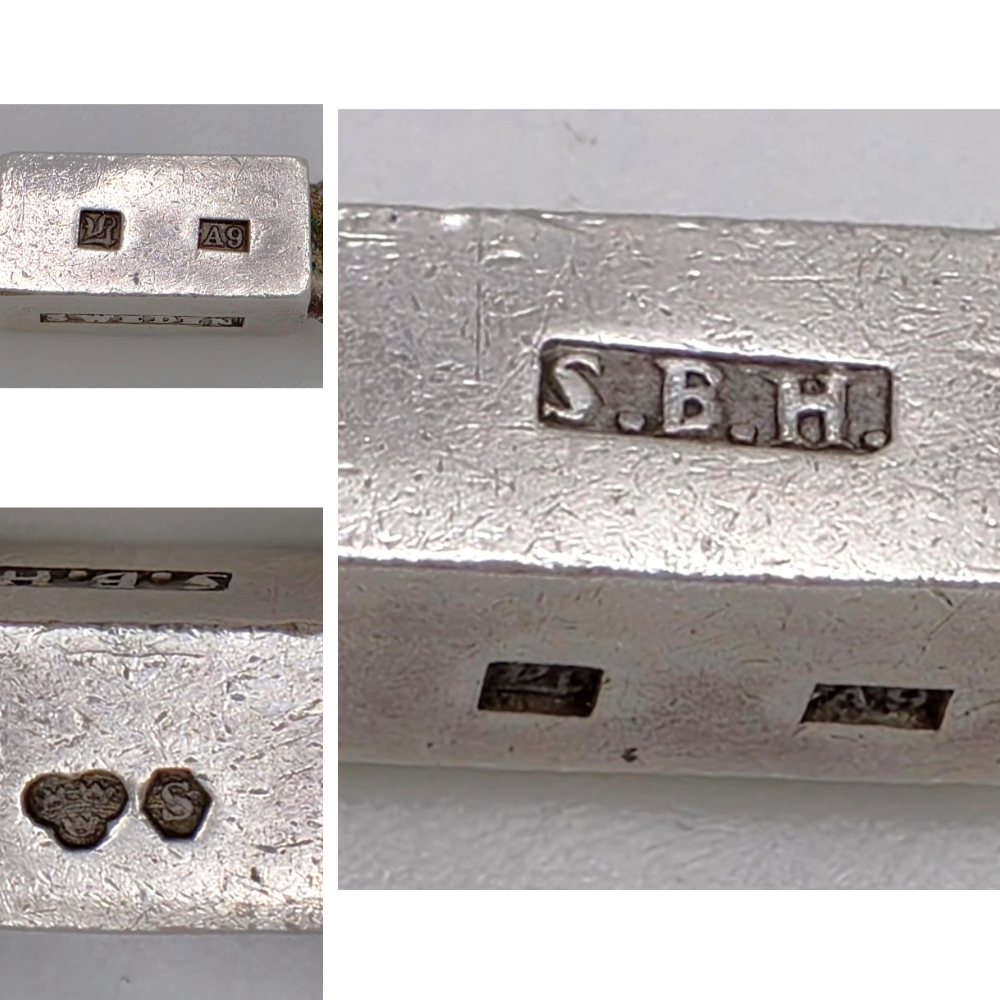
Necklace Markings: S.B.H. in a Rectangle Cartouche - S inside an Octagon Cartouche - Triple Crowns inside a Trefoil Cartouche - SWEDEN in a Rectangle Cartouche - A9 in a Rectangle Cartouche (Date mark for 1951) - City Mark for Lund in a Square Cartouche
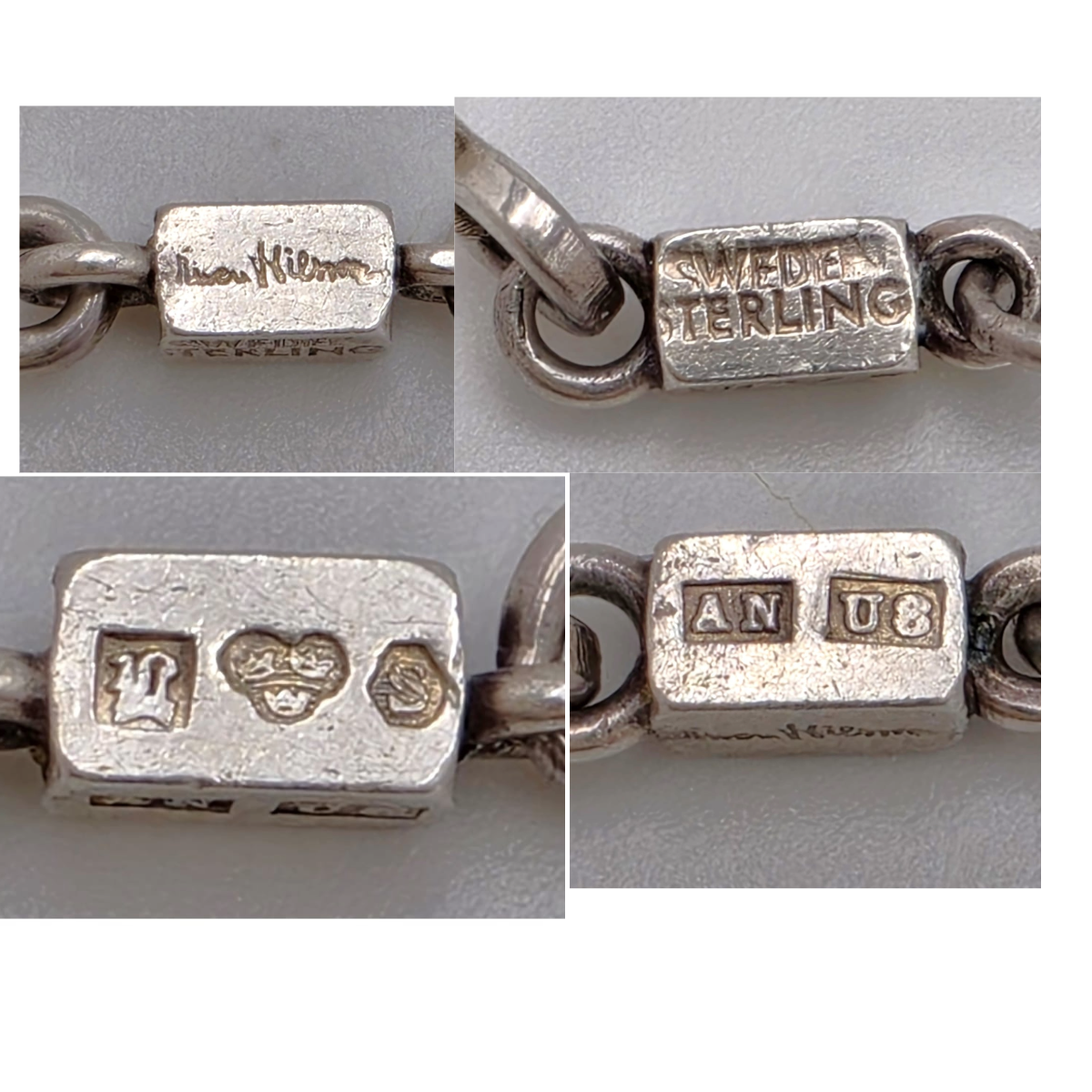
Bracelet Markings: Wiwen Signature - S inside an Octagon Cartouche - Triple Crowns inside a 3 Trefoil Cartouche - SWEDEN - STERLING - AN in a Rectangle Cartouche - U8 in a Rectangle Cartouche (Date mark for 1946) - City Mark for Lund in a Square Cartouche
Necklace Weight: 82.5g
Bracelet Weight: 9.9g
Total Set Weight: 92.4g
An exceptional coordinated Swedish Modernist jewelry set comprising a substantial sterling silver necklace by Sven Börje Hasselgren and a complementary bracelet by Wiwen of Lund, Sweden.
Both pieces feature a beautifully restrained geometric design composed of polished rectangular sterling-silver stations joined by double circular links. The alternating angular and rounded forms create a clean architectural rhythm characteristic of Scandinavian Modern design. Elegant yet remarkably wearable, the necklace has an impressive 22.5-inch length and a substantial weight of 82.5 grams.
Although made by two different Lund silversmiths five years apart, the necklace and bracelet share such closely related proportions and construction that they display beautifully together.
The necklace bears the maker’s mark S.B.H. for Sven Börje Hasselgren, Sweden’s national sterling and assay marks, the Lund city mark, and the date code A9 for 1951. Hasselgren’s Guld- & Silversmedjan workshop operated in Lund under the S.B.H. mark from approximately 1949 to 1968.
The bracelet is signed Wiwen and marked AN, together with STERLING, SWEDEN, the Swedish national assay marks, the Lund city mark, and the date code U8 for 1946. The AN maker’s mark is associated with A. Nilsson/Hasselgrens Eftr. in Lund, while the Wiwen firm operated under AB Wiwen from 1946 to 1975. Its combination of marks and 1946 date places this bracelet at an especially interesting transitional point in the company’s history.
A superb and highly collectible pairing for admirers of Swedish silver, Scandinavian Modernism, and mid-century studio jewelry.
The mannequin shown is a life-size torso representation and is included only to demonstrate scale and wearing length. Please review all photographs carefully, as they form an important part of the description.
Sven Börje Hasselgren
Was a Swedish goldsmith and silversmith active in Lund during the mid-20th century. His workshop, Guld- & Silversmedjan Sven Börje Hasselgren, registered the maker’s mark SBH in Lund from 1949 until 1968.
Hasselgren produced both gold and sterling-silver jewelry, including rings, necklaces, bracelets, and geometric link designs reflecting the clean forms of postwar Scandinavian Modernism. Surviving examples bear the SBH maker’s mark together with Swedish national assay marks, the Lund city mark, and the appropriate year code.
Hasselgren worked in the same small but influential Lund silversmithing community associated with Wiwen Nilsson. Auction records document at least one SBH bracelet described as a commissioned piece made in a design closely corresponding to a Wiwen Nilsson necklace. This evidence suggests that Hasselgren’s workshop was capable of producing complementary jewelry in the geometric Lund Modernist tradition, although a formal partnership or employment relationship between Hasselgren and Nilsson has not been formally confirmed.
Unlike Wiwen Nilsson, Hasselgren has not been the subject of a major published monograph or museum biography. Consequently, his surviving hallmarked work provides much of the available record of his career. Jewelry bearing his SBH mark is comparatively uncommon and represents a lesser-documented branch of Swedish mid-century studio jewelry.
Sweden’s National Museum also explains the workshop lineage: Anders Nilsson trained with Lund silversmith Johan Petter Hasselgren, took over the historic Hasselgren firm in 1899, and Wiwen assumed control in 1927.
Wiwen Nilsson
Karl Edvin “Wiwen” Nilsson was born in Copenhagen on May 19, 1897, and grew up in Lund, Sweden. He became one of Sweden’s most important 20th-century silversmiths and an internationally recognized leader in Scandinavian Art Deco and Modernist design.
Nilsson learned the silversmith’s trade in the Lund workshop of his father, Anders Nilsson, and continued his artistic and technical education in Germany and Paris. His studies exposed him to European modernism, sculpture, traditional metalworking, and the emerging geometric ideas that would define his mature work.
He made his professional debut at the 1923 Gothenburg Jubilee Exhibition. Although his radical geometric designs initially divided Swedish critics, Nilsson received a gold medal at the influential 1925 Paris International Exhibition of Modern Decorative and Industrial Arts. His work was subsequently exhibited at major American institutions, including the Metropolitan Museum of Art, the Minneapolis Institute of Art, and the Art Institute of Chicago.
Nilsson assumed control of his father’s Lund workshop in 1927 and was appointed jeweler to the Swedish Royal Court in 1928. His austere designs received major critical acclaim at the 1930 Stockholm Exhibition, helping establish him as a leading figure in Swedish Modernism. His jewelry is distinguished by precisely balanced geometric forms, polished silver surfaces, articulated bar-and-ring chains, crosses, and dramatic settings of rock crystal, onyx, and other stones.
During the 1940s, Nilsson’s work was exhibited and sold in New York, where his jewelry appeared alongside Orrefors glass and sculpture by Carl Milles. He received another gold medal at the 1951 Milan Triennale and was later awarded several prominent Swedish honors, including the Prince Eugen Medal for artistic achievement.
Wiwen Nilsson continued working in Lund until late in his life and died on January 8, 1974. His work is represented in numerous international collections, including the National Museum in Stockholm, the British Museum, the Victoria and Albert Museum, Design Museum Danmark, the National Museum in Norway, and the Minneapolis Institute of Art. Today he is celebrated for transforming traditional Swedish silversmithing through an uncompromising modern vocabulary of geometry, proportion, rhythm, and exceptional craftsmanship.
Swedish Records of Marks:
AN 1929 1946 Nilsson A Hasselgrens Eftr
Wiwen
220 00 Lund
AN 1946 1975 Nilsson Ab Wiwen
220 00 Lund
SBH 1949 1968 Guld-Silversmedjan
Sven Börje Hasselgrens
220 00 Lund
Returns policy
We have a 14-day return policy, which means you have 14 days after receiving your item to request a return.
To be eligible for a return, your item must be in the same condition that you received it, unworn or unused, with tags (if applicable) and in its original packaging.
To start a return, you can contact us at: customerservice@trendymodernhome.com
If your return request is accepted, we will email you with the return address and any additional information needed. Items sent back to us without first requesting a return will not be accepted.
You can always contact us for any return questions at: customerservice@trendymodernhome.com
Damages and issues
Please inspect your order upon reception and contact us immediately if the item is defective, damaged or if you receive the wrong item, so that we can evaluate the issue and make it right.
Exceptions / non-returnable items
Unfortunately, we cannot accept returns on gift cards.
European Union 14 day cooling off period
Notwithstanding the above, if the merchandise is being shipped into the European Union, you have the right to cancel or return your order within 14 days, for any reason and without a justification. As above, your item must be in the same condition that you received it, unworn or unused, with tags, and in its original packaging. You’ll also need the receipt or proof of purchase.
Refunds
We will notify you once we’ve received and inspected your return, and let you know if the refund was approved or not. If approved, you’ll be automatically refunded on your original payment method within 10 business days. Please remember it can take some time for your bank or credit card company to process and post the refund too.
If more than 15 business days have passed since we’ve approved your return, please contact us at: customerservice@trendymodernhome.com